
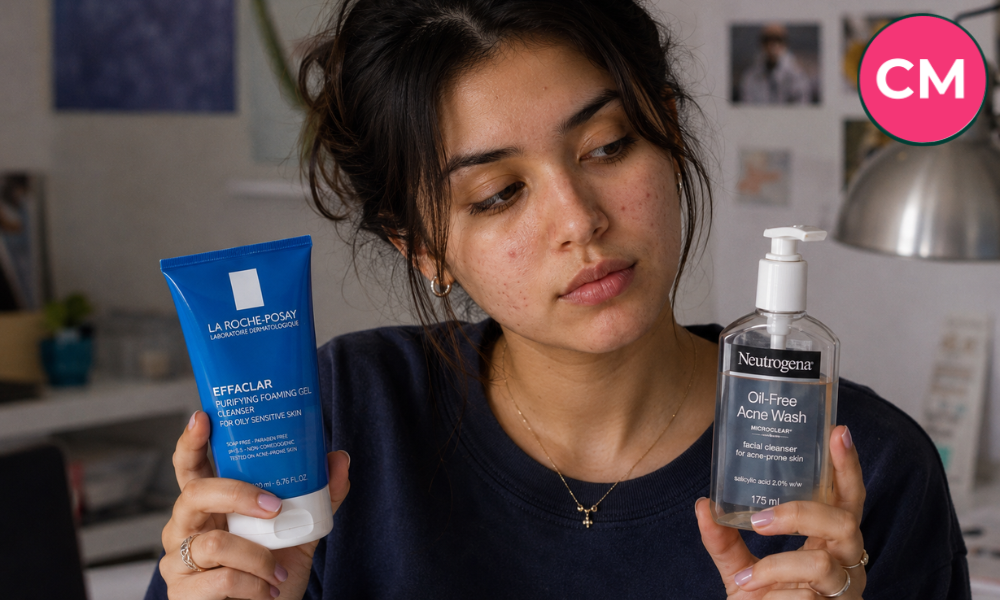

Between 8 a.m. classes, dining hall food, and pulling an all-nighter before finals, your skin is usually the first thing to show the damage. If you’ve stood in the skincare aisle at Target holding a Neutrogena bottle in one hand and a La Roche-Posay tube in the other, wondering which one is actually worth your limited budget, you’re not alone.
La Roche-Posay tends to work better for acne-prone skin that’s also sensitive, dry, or easily irritated, mainly because its formulas pair active ingredients with barrier-supporting extras like niacinamide and thermal spring water. Neutrogena tends to work better if your skin is oily and resilient and you want strong, fast-acting acne treatment at a lower price. Neither brand is objectively “better” across the board. The right one depends on your skin type, how your skin reacts to actives, and what you’re willing to spend each month.
Let’s break down what’s actually in these products, how they compare on price, and how to build a routine that won’t wreck your skin (or your budget) halfway through the semester.
Why College Skin Breaks Out More Than It Used To
Acne doesn’t usually show up out of nowhere in college. It’s the direct result of a lifestyle shift most students go through at once: irregular sleep, dining hall meals heavy in sugar and oil, higher stress hormones during exam weeks, and skipping your skincare routine because you fell asleep with your makeup on again.
Add pillowcases that don’t get washed often enough, gym equipment, and touching your face during long study sessions, and you’ve got a near-perfect setup for clogged pores. This is why so many students land on the same two brands in their search for a fix. Both La Roche-Posay and Neutrogena are widely stocked, dermatologist-recognized, and formulated specifically with acne-prone skin in mind. But “recognized” doesn’t mean “identical,” and the differences matter more than most product descriptions let on.
What’s Actually Inside These Products
Acne forms when a pore gets clogged with oil, dead skin cells, and bacteria, which then triggers inflammation. Almost every effective acne product on the market targets one or more of those three causes, and the ingredient list tells you exactly how it’s doing that.
The ingredients you’ll see most often across both brands:
- Benzoyl peroxide kills the bacteria that cause inflamed, painful breakouts. It’s available in different strengths, and lower concentrations tend to be just as effective as higher ones while causing less irritation.
- Salicylic acid is oil-soluble, so it gets into the pore itself and helps clear out the debris that leads to blackheads and whiteheads.
- Adapalene (a retinoid) speeds up cell turnover so pores are less likely to clog in the first place. It’s more of a prevention tool than a spot treatment.
- Niacinamide calms redness and helps repair the skin barrier, which matters a lot if your acne treatment is also drying you out.
- Zinc PCA helps regulate oil production without stripping the skin.
La Roche-Posay’s Effaclar line leans on a combination of salicylic acid, LHA (lipo-hydroxy acid, a gentler cousin of salicylic acid), niacinamide, and zinc PCA, often finished with the brand’s signature thermal spring water. The formulas are built around the idea that treating acne shouldn’t come at the cost of a damaged skin barrier.
Neutrogena’s acne lineup, including the Rapid Clear and Oil-Free Acne Wash ranges, tends to go with benzoyl peroxide and salicylic acid at strengths designed to clear breakouts quickly. The trade-off is that these formulas are less focused on soothing ingredients, so they can be more drying if you’re not careful about how often you use them.
Neither approach is wrong. It genuinely comes down to whether your skin needs gentleness or firepower.
La Roche-Posay vs Neutrogena: Side-by-Side Comparison
| Category | La Roche-Posay | Neutrogena |
| Core acne ingredients | Salicylic acid, LHA, niacinamide, zinc PCA | Benzoyl peroxide, salicylic acid |
| Best for | Sensitive, reactive, or dry acne-prone skin | Oily, resilient skin that tolerates strong actives |
| Barrier support | Strong (niacinamide, thermal spring water) | Minimal in most acne-specific products |
| Speed of visible results | Moderate, more gradual | Often faster, especially with benzoyl peroxide |
| Typical price range | Higher end of drugstore pricing, often $18 to $30 per product | Lower end of drugstore pricing, often $8 to $16 per product |
| Where to find it | CVS, Target, Ulta, Amazon, dermatology offices | CVS, Target, Walgreens, Amazon, most grocery stores |
| Fragrance-free options | Common across the acne line | Available but less consistent |
Pricing will vary by retailer and whether something’s on sale, but this gives you a realistic sense of the gap. If you’re buying a full routine (cleanser, treatment, moisturizer) in either brand, expect La Roche-Posay to run noticeably more per month than a comparable Neutrogena setup.
Choose La Roche-Posay If
- Your skin gets red, tight, or flaky when you try new acne products.
- You deal with both acne and dryness at the same time.
- You have a history of reacting badly to strong actives like high-strength benzoyl peroxide.
- You’re willing to spend a bit more for a gentler, more consistent routine.
Choose Neutrogena If
- Your skin is oily and rarely reacts badly to new products.
- You want visible improvement in your breakouts within a couple of weeks rather than a couple of months.
- You’re working with a tight budget and need effective basics without the higher price tag.
- You mainly deal with surface-level breakouts rather than deep, cystic acne.
Building a Realistic Routine on a Student Budget
You don’t need eight products to treat acne. A simple, consistent routine usually beats an expensive, complicated one, especially when you’re also juggling a class schedule.
- Cleanse with a gentle, non-comedogenic face wash morning and night. Both brands offer solid options here, and this is the one category where brand differences matter the least.
- Treat with one active ingredient at a time. Don’t layer benzoyl peroxide and adapalene on the same night when you’re starting out. Pick one, use it consistently for several weeks, and see how your skin responds before adding anything else.
- Moisturize, even if your skin is oily. Skipping moisturizer because your skin feels greasy usually backfires, since dehydrated skin tends to overproduce oil to compensate.
- Apply SPF every morning, especially if you’re using a retinoid like adapalene or an exfoliating acid. These ingredients make your skin more sensitive to sun exposure, which matters if you’re walking across campus in daylight.
If you want to combine both brands, a common approach is a gentle La Roche-Posay cleanser in the morning, a Neutrogena benzoyl peroxide spot treatment on active breakouts, and a barrier-supporting moisturizer at night. Mixing brands isn’t a problem as long as you’re not stacking multiple strong actives at once.
A Word on Purging vs. Breaking Out
If you start a new active ingredient, especially adapalene or a stronger salicylic acid product, and your skin looks worse before it looks better, that’s often purging rather than a bad reaction. Purging happens because these ingredients speed up cell turnover, bringing existing congestion to the surface faster than it would have appeared naturally. It typically settles down within four to six weeks.
The difference between purging and a genuine bad reaction comes down to location and severity. Purging tends to show up in areas you already break out in and gradually improves. A true reaction usually causes new redness, burning, or breakouts in areas that weren’t previously a problem, and it tends to get worse rather than better the longer you use the product.
If a product is genuinely making things worse after a month of consistent use, stop and reassess rather than pushing through.
When Over-the-Counter Isn’t Enough
Both La Roche-Posay and Neutrogena are solid options for mild to moderate acne, but neither is designed to treat severe, cystic, or deeply hormonal acne on its own. If you’ve been consistent with a routine for eight to ten weeks and you’re not seeing meaningful improvement, or if you’re dealing with painful, deep breakouts, it’s worth checking whether your campus health center offers dermatology referrals. Many do, and student health insurance often covers at least a consultation.
Read More: https://correctmagazines.com/competitive-edge-theserpentrogue/
FAQs
Which is better for acne, La Roche-Posay or Neutrogena?
It depends on your skin type. La Roche-Posay is generally better for sensitive or dry acne-prone skin because of its barrier-supporting ingredients. Neutrogena tends to work faster on oily, resilient skin that tolerates stronger actives well.
Is La Roche-Posay worth the extra money over Neutrogena?
If your skin reacts badly to harsher treatments, the extra cost is often worth it for fewer flare-ups and less irritation. If your skin tolerates strong actives fine, you may not need to pay more to get similar results from Neutrogena.
What ingredients does La Roche-Posay use for acne?
Its Effaclar line typically combines salicylic acid, LHA, niacinamide, and zinc PCA, along with the brand’s thermal spring water for added soothing.
Does Neutrogena work for sensitive acne-prone skin?
It can, but you’ll want to start with lower-strength products and fragrance-free options, since many of its acne treatments use benzoyl peroxide, which can be drying at higher concentrations.
Can I use La Roche-Posay and Neutrogena products together?
Yes, combining brands is common and generally fine, as long as you’re not layering multiple strong active ingredients on the same night. Introduce one active at a time and watch how your skin responds.
What is the best budget skincare routine for college students with acne?
A basic routine of a gentle cleanser, one active treatment, a moisturizer, and daily SPF covers most needs without requiring a large product collection or a big budget.
How long does it take for acne products to work?
Most people need six to eight weeks of consistent use before seeing significant improvement. Some redness or new breakouts in the first few weeks can be normal purging rather than a sign the product isn’t working.
Is La Roche-Posay good for hormonal acne?
It can help manage hormonal breakouts, particularly because its formulas reduce irritation while still treating acne, but hormonal acne that’s severe or cystic often benefits from a dermatologist’s input alongside any over-the-counter routine.
The Bottom Line
So, are La Roche-Posay products better for acne-prone skin than Neutrogena? For sensitive, reactive, or dry skin, yes, La Roche-Posay usually delivers a more comfortable and sustainable routine. For oily, resilient skin on a tighter budget, Neutrogena often gets you similar results for less money and less waiting.
The best move isn’t picking a brand and hoping for the best. It’s identifying what your skin actually needs, starting with one product at a time, and giving it enough weeks to actually work before switching things up. Pay attention to how your skin responds over the first month, adjust from there, and don’t be afraid to mix and match between the two brands if that’s what your skin ends up needing.